
Brain2Qwerty Is Not Mind Reading. That Is Why It Matters.
The Short Version
Meta just showed a new version of Brain2Qwerty, an AI system that can turn brain activity into typed text.
That sentence sounds like science fiction.
It is not quite that.
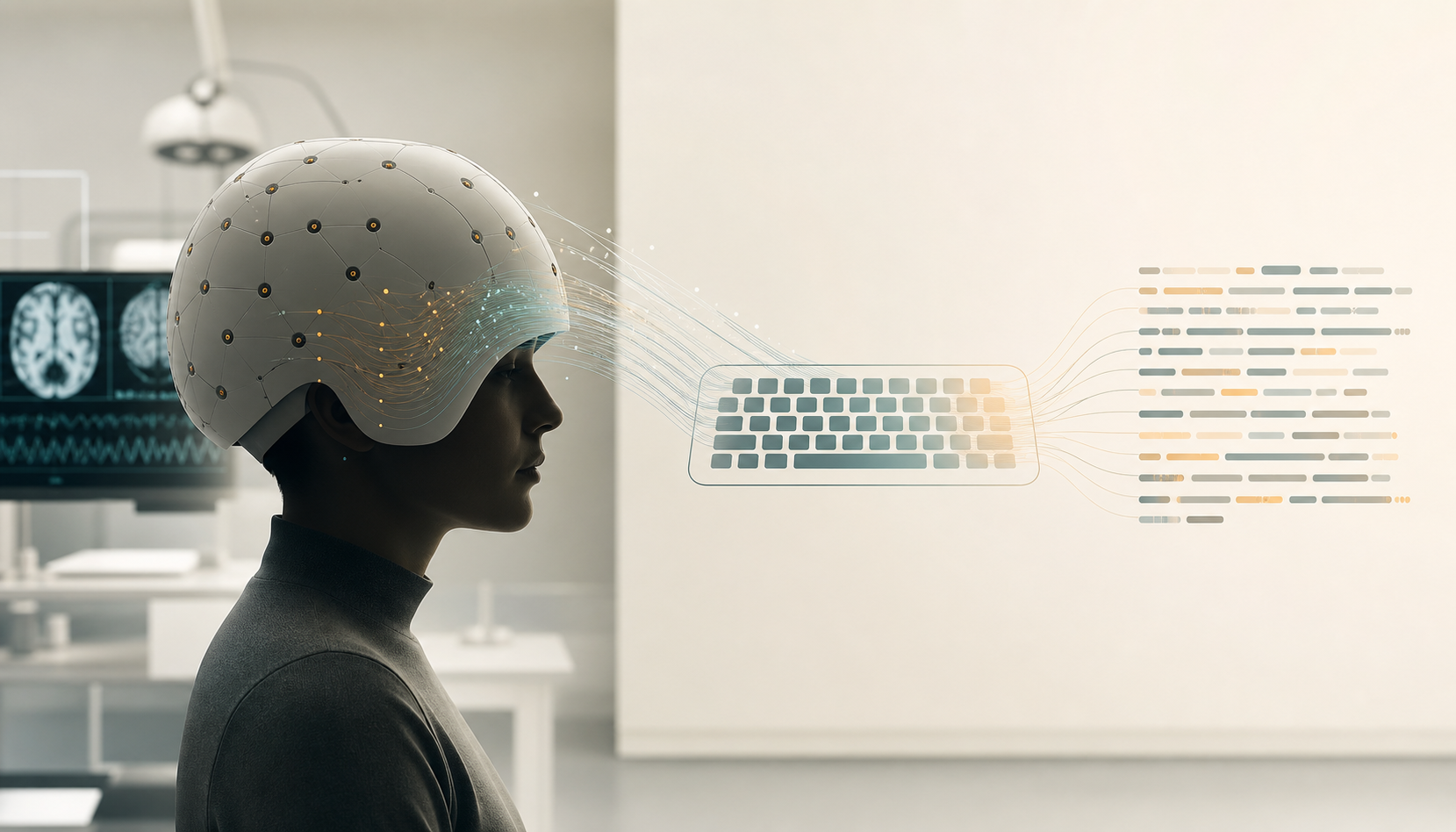
According to Meta's research post, the latest version of Brain2Qwerty was trained on roughly 22,000 sentences recorded from nine volunteers while they typed. Each participant spent about 10 hours inside a magnetoencephalography, or MEG, scanner. The system then tried to decode what they were typing from their brain activity in real time.
Meta says the new model reached 61% word accuracy on average, with the best participant reaching 78%.
That is impressive.
It is also not "AI can read your private thoughts."
The useful way to understand Brain2Qwerty is simpler and more interesting: AI is getting good at translating messy human signals into usable computer actions. Speech. Gestures. Screens. Code. And now, in a lab, neural activity around typing.
The next interface may not be a better chat box.
It may be a translator between what you mean and what the computer can do.
What Meta actually announced
Brain2Qwerty is a research project from Meta AI and collaborators at the Basque Center on Cognition, Brain and Language.
The first version, published in Nature Neuroscience, used non-invasive brain recordings to reconstruct text while people typed sentences from a prompt. Meta says that version used 35 healthy volunteers and reached 29% character error rate with MEG.
The new version, Brain2Qwerty v2, pushes the system closer to real-time decoding. Instead of only reconstructing text after the fact, the model generates sentence predictions from continuous brain activity while the participant is typing.
The pipeline is not just a brain scanner plugged into ChatGPT.
It combines MEG signals, a language model, and a search process that tries to find the most likely text sequence. Meta also says it used AI agents to explore possible decoding strategies, then manually selected the final configuration.
That detail matters.
The model is not reading an isolated thought. It is using a lot of structure: the participant is in a scanner, doing a constrained typing task, producing language, and the system is using statistical expectations about language to clean up the signal.
In normal language: the brain signal is noisy, and the language model helps guess what the sentence probably was.
That is still a big deal.
It is just not magic.
The "mind reading" headline is wrong
The internet is going to flatten this into a creepy sentence:
AI can read your thoughts.
No.
At least, not from this.
Brain2Qwerty does not show a consumer device that knows what you are secretly thinking while you walk around the city. It does not show Meta decoding private memories from across the room. It does not show a pair of smart glasses silently turning your inner monologue into a Facebook post.
It shows a lab system decoding text-related brain activity from people who are actively typing known-style sentences inside a large scientific instrument.
That distinction is not pedantic. It is the whole story.
MEG is powerful because it can measure magnetic fields generated by brain activity with very fine timing. It is also expensive, sensitive, and not something you casually wear to a coffee shop. The participants were healthy volunteers, not locked-in patients. The task was typing, not spontaneous thought. The results vary a lot by person.
So if your immediate question is, "Should I worry that Meta can read my mind today?"
No.
If your question is, "Should I pay attention to AI turning more human signals into machine-readable interfaces?"
Yes.
That is the real shift.
The real product is translation
Most AI interface stories are secretly translation stories.
Vibe coding is translating intent into code.
Agents are translating goals into tasks.
Voice assistants translate speech into actions.
Multimodal models translate screenshots, documents, images, and videos into useful context.
Brain2Qwerty is another version of the same pattern, just much closer to the body.
The important object is not the brain scanner. The important object is the translation layer.
You have a noisy signal on one side: neural activity, a messy Slack thread, a screenshot, a vague prompt, a half-finished spreadsheet, a customer support conversation.
You have a useful action on the other side: text, code, a decision, a search query, a task, a file, a response.
The model sits between them and tries to make the signal operational.
That is why this research belongs in the same mental bucket as AI agents, even though it is not an agent product. Agents need interfaces. They need ways to understand human intent that are richer than a blank prompt box.
Today that usually means text.
Tomorrow it may mean speech, screen state, calendar context, eye movement, gesture, environment, and, for some specialized cases, neural signals.
The interface is becoming less like "type a command" and more like "give the system enough evidence to infer the job."
That is powerful.
It is also where the weirdness starts.
Why this matters for accessibility
The obvious good version of this technology is assistive communication.
If someone cannot speak or type, a brain-computer interface that turns intention into text could be life-changing. That is why this field matters beyond the tech-demo cycle. Text is not just productivity. Text is agency.
But the path from Meta's lab result to a usable assistive device is not short.
A practical system would need to work outside a giant scanner, across more people, with less calibration, lower cost, higher accuracy, and real-world reliability. It would also need to handle fatigue, mistakes, privacy, consent, medical constraints, and the emotional reality of depending on a system to communicate.
That is a harder product than a benchmark table.
Still, the direction is meaningful.
The old idea of a brain-computer interface often sounded like hardware first: implant, electrode, headset, sensor, device.
Brain2Qwerty shows why software may be just as important. The model is the thing that turns a weak signal into a usable signal. Better language models do not just answer questions. They make more kinds of input legible to computers.
That is the practical frontier.
Not "the machine knows your soul."
More like: the machine can help map a noisy intention into a useful output.
Still spooky sometimes. But different.
The privacy problem arrives early
Here is the uncomfortable part.
Even if Brain2Qwerty is nowhere near consumer mind reading, neural data is still sensitive.
Companies do not need perfect thought decoding for privacy to matter. They just need signals that reveal patterns about attention, fatigue, preference, emotion, impairment, or intent. The history of technology is basically: if a signal can be measured, someone will try to optimize, monetize, or litigate around it.
That does not mean every brain-interface researcher is building a surveillance machine.
It means the rules should arrive before the product gets normal.
Who owns the neural data? Can it be reused for training? Can an employer require a brain-sensing productivity tool? Can an insurer ask for cognitive-signal data? What counts as consent when the data is generated by your body before you have turned it into words?
Those sound like future questions.
They are not that far away.
The lesson from the last decade is that interfaces get adopted first and governed later. Cameras, microphones, location, cookies, face recognition, wearables, workplace analytics. Same movie, different sensor.
Brain data should not get the "ship first, apologize later" treatment.
What to watch now
There are three things worth watching.
First: whether the accuracy keeps improving without invasive hardware. If non-invasive systems can reliably decode intended text in constrained settings, the assistive use case becomes more credible.
Second: whether the system can move beyond giant MEG scanners. Research labs can tolerate expensive equipment and long calibration sessions. Real products cannot.
Third: how much of the progress comes from better sensors versus better models. My guess is both. But the AI part is easy to underestimate. A smarter language model can make a messy signal look much cleaner by using context.
That is also the risk.
The same predictive layer that makes the system useful can also make mistakes feel fluent. If the decoder guesses the wrong sentence beautifully, the output may look more certain than the signal deserves.
Anyone who has used a chatbot knows this pattern.
Confidence is not the same as correctness.
In a brain-computer interface, that matters a lot.
The bottom line
Brain2Qwerty is not a mind-reading machine.
That is the boring, responsible sentence.
The more interesting sentence is this:
AI is making more of the human world computable.
Not just typed prompts. Not just code. Not just images and voice. Slowly, carefully, in labs, even neural activity around language production.
That does not mean we are five minutes from telepathy products. It means the boundary between human intent and machine action is getting softer.
Some of that will be wonderful. Especially for people who need new ways to communicate.
Some of it will be invasive if we let companies treat every new signal as just another data source.
So the right reaction is not panic.
It is attention.
Because the future interface may not ask you to write the perfect prompt.
It may try to infer what you meant before you fully typed it.
And that is useful enough, and strange enough, to deserve rules before it becomes normal.